MILES 4MISSIONSNov 16–18: Chuck and Joe walk and bike 80 miles for four NJ neighborsFollow the trek & donate
Mold testing and inspection, residential and commercial

Find out what is growing, where the water came from, and whether it is gone

A musty smell with nothing to see. A buyer's inspector who flagged the attic. A tenant who says the apartment makes them sick. A remediation that was "done" and a landlord who wants proof. Mold testing answers the question that visible mold does not: what is in the air and the walls you cannot open. We inspect the building, map the moisture, take air and surface samples for an independent laboratory and give you a written report that says what was found, what caused it and what to do about it. Homes, offices, schools, churches and multifamily buildings across New Jersey.

  • Moisture firstMeter and infrared on every visit
  • Independent labSamples analyzed by an accredited laboratory
  • 48 hrTypical turnaround on results
  • Source namedRoof, pipe, drainage or ventilation
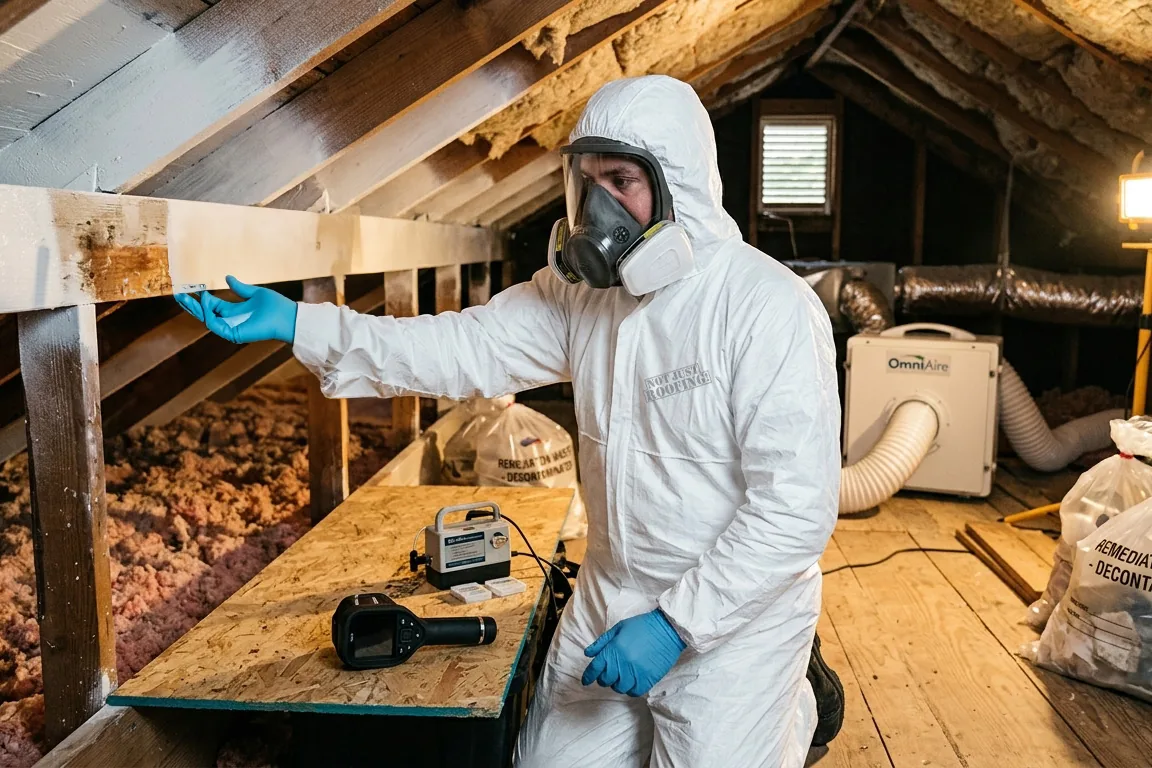
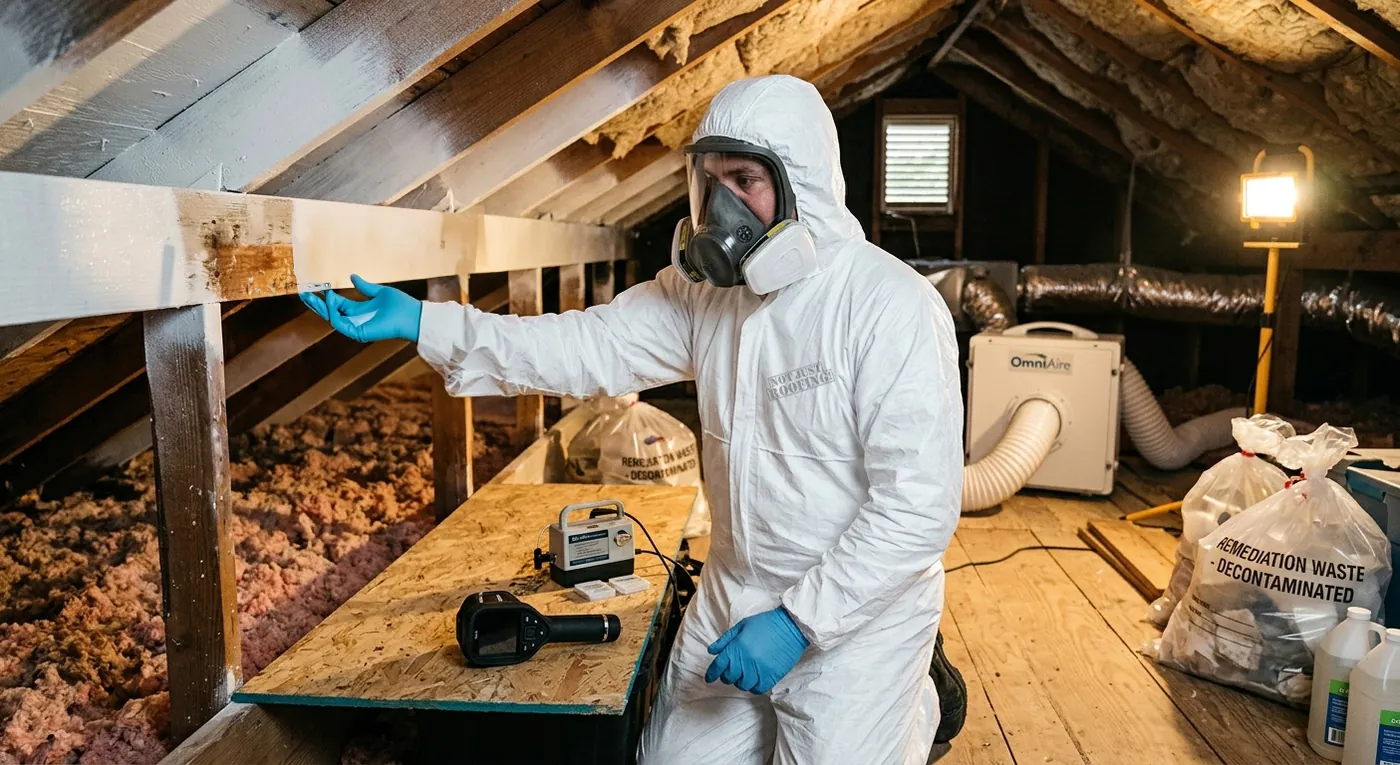
A Roof4Roof technician in a protective suit and respirator pointing at a stained rafter in an attic, with an air sampling pump and a moisture meter on the bench
An attic inspection: the stain on the rafter, the moisture reading behind it, and an air sample for the lab
  • Exterior Services Since 1990
  • 30M+ sq ft of Roofing & Exteriors Installed
  • 25,000+ Satisfied Clients
  • A Legacy of Giving: $1.5M+ Donated
What we test

Six things a mold inspection measures, and what each one tells you

A test is only as useful as the inspection around it. Samples taken without a moisture map tell you there is mold somewhere; the map tells you where the water is, which is what you actually need to fix.

01

Visual inspection

What: attic, basement, crawlspace, bathrooms, around windows, under sinks, at the roof-to-wall joints, with the history of the building from you.

Tells you: where to look harder. Most hidden mold has a visible clue: a stain, a bulge, a smell that is stronger in one corner.
02

Moisture mapping

What: pin and pinless moisture meters on wood, drywall and masonry, and a thermal camera to find the cool, damp areas behind finished surfaces.

Tells you: whether the water is still coming in. Dry materials with old staining are a past problem; wet ones are a current one.

03

Air sampling

What: a calibrated pump draws a measured volume of air through a cassette in the rooms in question and outdoors for a baseline. The lab counts and identifies the spores.

Tells you: whether the indoor air carries more, or different, mold than the air outside, which is the signal for hidden growth.

04

Surface sampling

What: tape lifts or swabs from a stain, a discolored joist, the back of a baseboard.

Tells you: whether a stain is mold at all, and which kind. Many "mold" stains are soot, dust or mineral deposits.

05

Cavity sampling

What: a small hole and a probe inside a wall or ceiling cavity where the moisture map says the water went.

Tells you: what is behind the drywall without opening the wall, so the remediation scope is right-sized before anyone starts cutting.

06

Post-remediation verification

What: after a remediation, with containment still up: a visual check for dust and residue, moisture readings, and air samples compared with outdoors.

Tells you: that the job is finished and the area can be rebuilt and reoccupied. The document a landlord, board or insurer asks for.

  • Whole-house and single-room mold inspections
  • Moisture mapping with meters and infrared
  • Air sampling with outdoor baseline, analyzed by an independent accredited laboratory
  • Surface tape and swab sampling
  • Wall and ceiling cavity sampling
  • Pre-purchase and pre-sale mold inspections
  • Post-remediation verification and clearance reports
  • Tenant complaint and landlord documentation
  • Commercial, school, church and multifamily inspections, phased around occupants
  • Written reports with photos, readings, lab results and recommendations
A Roof4Roof technician in a protective suit testing an attic rafter, with a moisture meter and sampling pump set up on a board
The reading, the sample and the photo all go into one report, with the cause named
The report

What you get, and what you can do with it

A lab result on its own is a page of spore counts. Our report puts the counts next to the moisture map and the photos and says, in plain English, what was found, where the water came from and what the next step is, with a price if that step is ours.

  1. 01
    FindingsEvery area inspected, the moisture readings, the thermal images and the photos of what we saw, room by room.
  2. 02
    Lab results, explainedIndoor samples compared with the outdoor baseline, the mold types named, and what the numbers mean for your building rather than a generic scale.
  3. 03
    The causeThe moisture source as we found it: a roof or flashing leak, a plumbing leak, groundwater, a bathroom fan venting into the attic, condensation from poor insulation or ventilation.
  4. 04
    Recommendations and a quoteNothing, monitoring, a source repair, or a remediation, with the scope and a written price. If it is nothing, the report says nothing.

If remediation is needed: our own crews contain, remove, clean and fix the source. See how a mold remediation runs with us.

Why Roof4Roof

A test that ends with the leak found, not just the mold counted

Most mold testers can tell you what is in the air. Very few can tell you why the attic was wet, because they have never been on a roof. We have been on New Jersey roofs since 1990, and that is where most of the water in an attic comes from. Four things we do on every inspection that most testers do not:

  • The roof and the drainage, not just the roomFlashings, vents, gutters and grading are inspected with the inside, because the source is usually outside.
  • An outdoor baseline on every air testWithout it a spore count means nothing. Every indoor sample is compared with the air outside your building on the same day.
  • Honest scopeIf the stain is not mold, or the problem is a dehumidifier, the report says so and we do not sell you a remediation.
  • The owners' direct line on every documentIssues answered within 48 hours, most within 24. The owners' contact details are printed on every report and invoice.

And a share of this job funds a roof for a family in need, through our One4One program.

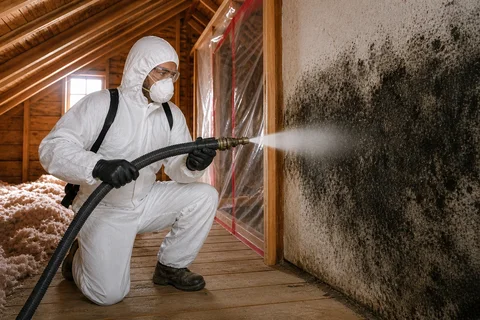
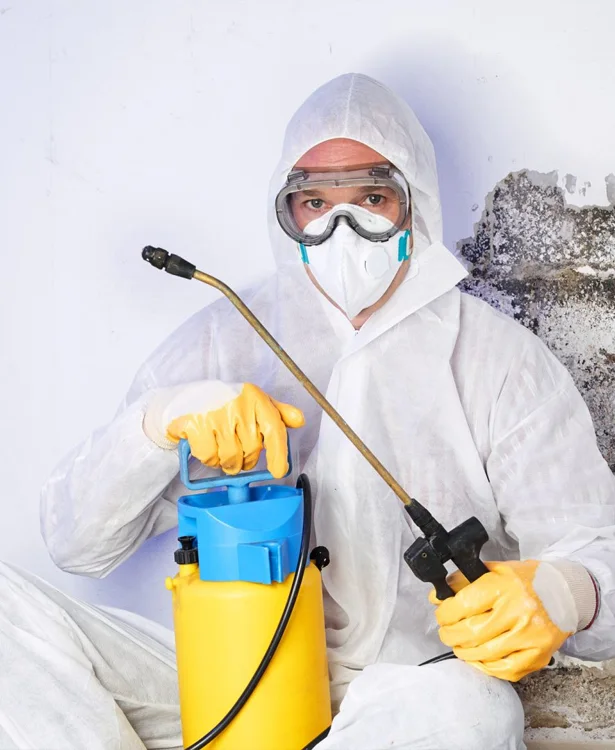
A Roof4Roof technician in protective gear inspecting a mold-stained wall
How it runs

How a mold inspection runs with us

Step 01

Call and history

What you smell or see, when it started, past leaks and repairs, who is affected. We tell you on the phone whether a test is worth it or you just need the mold removed.

01
Step 02

Inspect and sample

Two to three hours on site for a house: visual inspection, moisture mapping, thermal imaging, then the air and surface samples the findings call for, with an outdoor baseline.

02
Step 03

Lab and report

Samples go to an independent accredited laboratory, typically back within 48 hours. The report arrives with the results explained, the cause named and the next step priced.

03
Step 04

Fix, verify

If work is needed, our crews fix the source and remediate. A clearance test afterward, with the same lab, closes the file for you, your tenant, your board or your insurer.

04
Cost

What mold testing costs in New Jersey

The size of the building and the number of samples the findings call for decide the price. Lab fees are per sample and are listed on the proposal, so you see what the inspection costs and what the lab costs.

Mold inspection with moisture mapping
A flat fee by building size, with the written report and photos included
Air and surface samples
Priced per sample at the laboratory's rate, with the outdoor baseline included in every air test
Post-remediation verification
Inspection plus the samples needed to compare with outdoors; included in the price of a remediation we perform
Commercial and multifamily
Scoped per building; phased and scheduled around occupants

If the inspection leads to a remediation we perform, the inspection fee is credited against it.

If it is more than a test

Remediation and the source repair, by one company

Containment, removal and HEPA cleanup by our remediation crews, and the roof, flashing, gutter or drainage fix by our own roofers and masons, on one proposal. Residential financing through Service Finance Company for qualified applicants.

Mold remediation →

Insurance claim? We document the loss and work with your adjuster.

FAQ

Mold testing questions, answered straight

What New Jersey owners, buyers and landlords ask us before they book.

Have a question not listed here? Call (201) 267-3000 or book an inspection.

01I can see the mold. Do I still need a test?+

Usually not. Visible mold needs to be removed and the water source fixed whichever species it is, and the test would not change the work. Testing is for hidden mold, for disputes where someone needs numbers, and for proving a remediation worked. We will tell you on the phone if a test is a waste of your money.

02What is a "normal" amount of mold in the air?+

There is no legal indoor limit, which is why the outdoor baseline matters. Mold spores are everywhere; the question is whether the air inside carries noticeably more than the air outside, or kinds that are not present outside, which points to growth indoors. The report explains your numbers against your baseline.

03How long does a mold inspection take, and when do I get results?+

Two to three hours on site for a typical house, longer for a large or commercial building. Lab results typically come back within 48 hours, and the full report follows the same day.

04Can the same company test and remediate? Is that a conflict?+

The samples are analyzed by an independent accredited laboratory, not by us, and the report says "nothing needed" when that is the answer. If you want a separate firm for the clearance test after our remediation, we welcome it and will work to their protocol.

05My home inspector flagged mold in the attic. What now?+

Most attic "mold" findings are condensation staining from a bathroom fan venting into the attic or from poor ventilation, sometimes with real growth on the sheathing. We test the sheathing, check the roof, the vents and the fan ducts, and give you a report and a price you can take into the negotiation.

06Do you test for black mold specifically?+

Surface and air samples identify the mold types present, including the ones people mean by "black mold". In practice the colour does not decide what needs to happen: any mold growing indoors is removed and the moisture stopped.

07Will a test tell me if the mold is making someone sick?+

No. A mold test describes the building, not a person. If someone in the building has symptoms, their doctor is the right call; our report gives the doctor what is in the air and on the surfaces, which is often what they ask for.

08Where do you work?+

Homes across Northern and Central New Jersey, including Bergen, Hudson, Essex, Passaic, Morris, Union, Middlesex, Somerset, Hunterdon and Sussex counties. Commercial, institutional and multifamily inspections across the whole of New Jersey.

Reviews

From people whose buildings we dried out

Read all Google reviews →
★★★★★

"Roof4Roof was very professional, the employees were courteous and respectful with my property. The job was completed on time. All debris was cleaned and removed from the job site. We would not hesitate to recommend Roof4Roof."

Gregory St. LucePosted on Google
★★★★★

"Work was done on time as promised. The staff was very polite and professional. Work area was left very clean and neat. I had no problems with this project, they handled everything."

Candido NunezPosted on Google
★★★★★

"Good quality and good service at a great price. Special thanks go to John, who provided a lot of useful suggestions and made sure the workers did a good job."

Charles LiPosted on Google
One4One

A share of every job funds a roof, a repair or a home for a family in need, in New Jersey and abroad: $1.5M+ donated and 1,300+ families helped since 2010.

How One4One works →
Book an inspection

Know what is in the air before you decide anything

Moisture mapping, lab-analyzed samples with an outdoor baseline, and a report that names the cause and the next step. If the answer is "nothing", that is what it will say.

Request a Free Estimate

A real person calls you back within 24 hours.

Your information stays private. We never share your details.